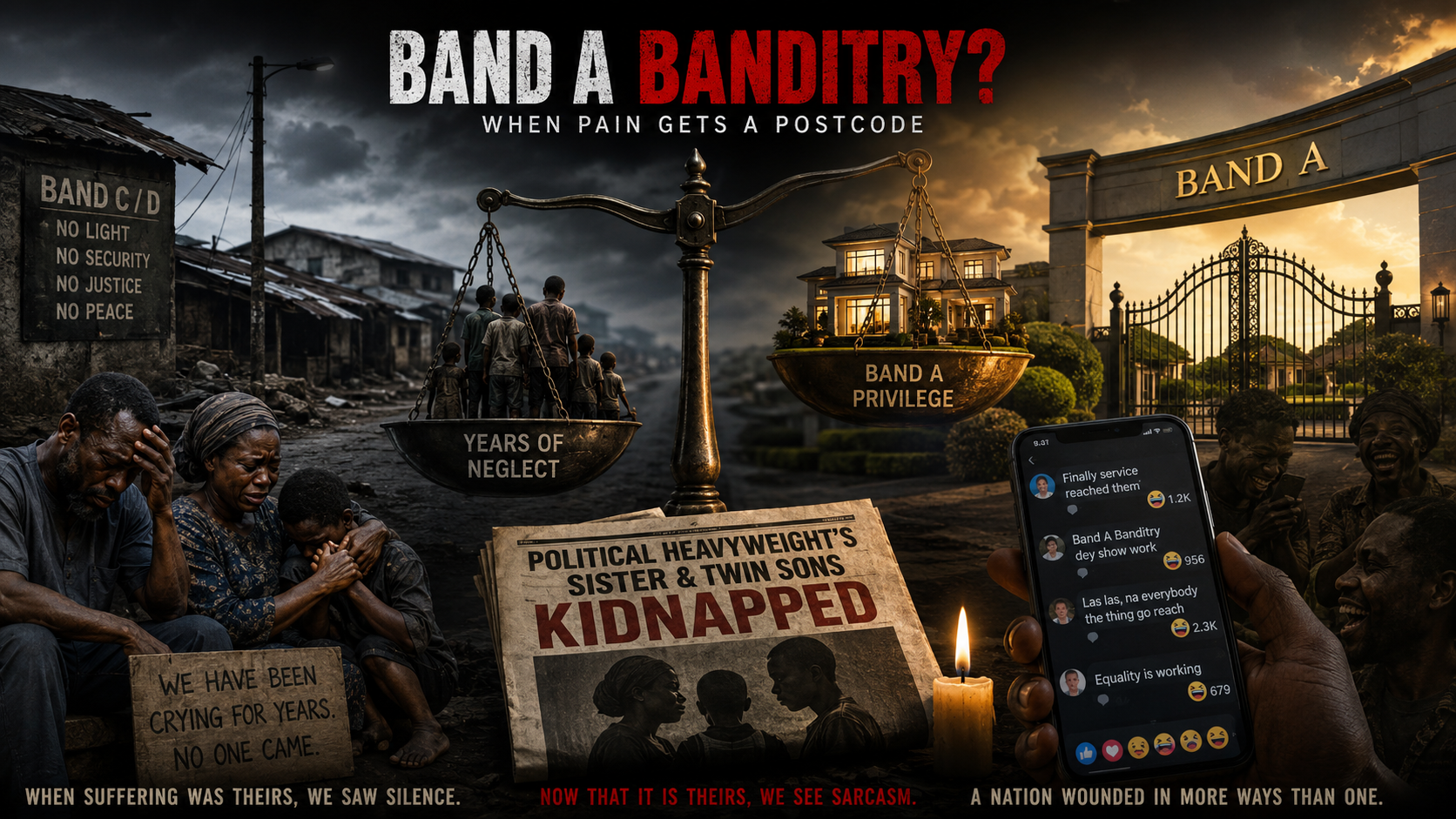
A Kidnap Has Exposed Something More Dangerous Than Kidnappers
Let me begin with a lesson in electricity, because Nigeria enjoys turning every national conversation into a metaphor.
We have Band A, Band B, Band C, and the rest of the alphabet arranged according to privilege, proximity, and the mysterious calculations of bureaucracy. Band A customers are promised more hours of power. Better service. Faster attention. A premium experience in a country where reliability has become a luxury product.
At least that is the theory.
Then came the news that a prominent political figure's younger sister and her twin sons had been kidnapped. A tragedy by every moral standard. The sort of news that should stop a nation in its tracks and summon sympathy from even the hardest hearts.
But Nigeria is a country where pain rarely travels alone.
Before the prayers came the punchlines.
Before the sympathy came the sarcasm.
Before the outrage came the memes.
"Band A Banditry," some called it.
The joke landed because the wound beneath it was already deep. Too deep.
For years, ordinary Nigerians screamed into darkness. Sometimes literally. They endured blackouts, insecurity, inflation, unemployment, collapsing infrastructure, and the peculiar exhaustion of living in a country that often feels like a test of spiritual endurance. They complained. They protested. They begged. They voted. They survived.
And through it all, many believed those in power lived behind invisible fences, protected from the consequences of the policies they designed, defended, or ignored.
Now the fences appear less invisible.
Now the monsters seem to have discovered premium addresses.
Now the insecurity that once prowled distant villages and anonymous highways is being perceived, rightly or wrongly, as knocking on more influential doors.
And the public reaction has been revealing.
I saw very little celebration of kidnapping. Nigerians understand suffering too well for that.
What I saw was something else.
I saw bitterness wearing the mask of humour.
I saw frustration disguised as satire.
I saw citizens so exhausted by inequality that they now interpret tragedy through the lens of balance.
"Las las, na everybody the thing go reach."
A terrible statement.
An even more terrible reality.
Because when people begin to view the spread of suffering as progress, something fundamental has broken in the social contract.
A healthy society mourns victims.
An injured society investigates victims.
A wounded society ranks victims.
But a deeply broken society starts applauding when pain changes neighbourhoods.
That is where the danger lies.
Not merely in the kidnapping.
Not merely in the insecurity.
But in the gradual erosion of compassion itself.
Every kidnapping is a failure of the state. Every victim deserves sympathy. Every family deserves justice. It should not matter whether the victim is a farmer, a trader, a teacher, a student, or the relative of a political heavyweight.
Pain should not require a class designation.
Fear should not have a tariff structure.
And grief should never become a tool for settling political accounts.
Yet here we are.
The kidnappers are becoming bolder.
The people are becoming harder.
And somewhere between public outrage and public amusement, a nation is quietly losing its ability to feel together.
That should worry us all.
Because when citizens start treating insecurity as the great equaliser, it means they have lost faith in every other mechanism of justice.
The kidnappers took a family.
But the reactions reveal that something else has also been taken.
Hope.
And unlike ransom, hope is much harder to recover.
Select Thoughts & Perspectives
It's actually all true, the moral decadence and the rugged lifestyle we have adapted to and have accepted to be normal is just sad to say. I hope that there would be a positive turn of event in future generations to come.
It is sad indeed, a gradual erosion of our humanity.May God show us all mercy.