LASSA FEVER: THE SILENT KILLER...
This Disease Comes Every Year… And We Still Act Surprised
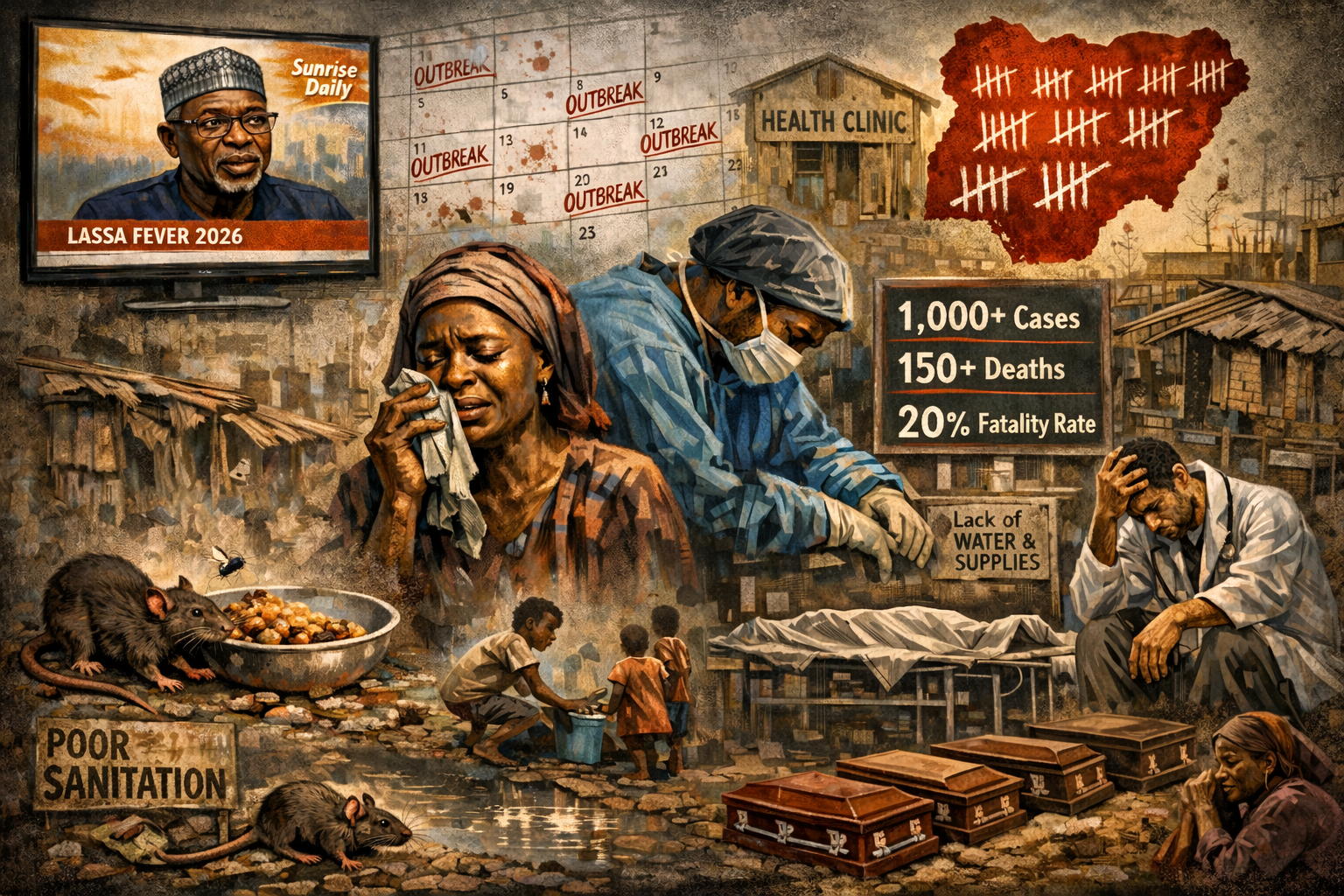
Yesterday morning, I listened to Professor Ishaku Akyala speak on Sunrise Daily.
And what I heard was not just a medical briefing.
It was a mirror.
We like to believe tragedy is random.
But in Nigeria, it rarely is.
Because how do you explain a disease that comes every year…
At the same time…
In the same regions…
Killing in the same pattern?
That is not chance.
That is design.
Lassa fever has been with us since 1969.
Over 50 years.
And still, here we are in 2026…
Counting deaths like it is new.
According to the Nigeria Centre for Disease Control, the country has already recorded:
- 1,000+ confirmed cases in the early part of the year
- 150+ deaths
- A fatality rate approaching 20% in severe cases
- Spread across 20+ states
Every number is a signal.
And yet, this disease is not complicated.
It is preventable.
It is treatable.
It is seasonal.
So why are people still dying like this?
Because this is no longer about the virus.
It is about the system that allows the virus to win.
Lassa fever lives where structure is weak.
In uncovered food.
In rodent-infested homes.
In poor sanitation.
In hospitals that struggle with basic hygiene.
And here is where it becomes uncomfortable.
Because during COVID-19, Nigeria showed capacity.
We saw urgency.
Lockdowns happened.
Testing centres multiplied.
Funding appeared.
Communication became aggressive.
Even fear had structure.
We moved like a country that understood threat.
But Lassa fever has been killing Nigerians quietly for decades.
And the response has remained… quiet.
There is a Nigerian proverb that says:
“When a child dies repeatedly in the same house, you do not call it coincidence.”
At some point, you stop blaming the illness.
You start questioning the house.
Because the deeper data tells a harder story:
- 70–80% of primary healthcare centres lack reliable water
- Under-five mortality still sits above 100 per 1,000 births
- Maternal mortality exceeds 500 per 100,000 births
- Many states cannot test Lassa fever locally
- Samples still travel long distances before confirmation
This is not pressure.
This is absence.
And then comes the part that should disturb anyone paying attention.
Nigeria has not developed a single widely adopted indigenous diagnostic tool for Lassa fever.
In over 50 years.
For a disease that lives here.
That is not lack of intelligence.
It is lack of intention.
Even more unsettling…
Doctors are dying.
From something preventable.
When the system cannot protect those trained to protect others…
The failure is already complete.
We like complex solutions.
Vaccines.
Funding.
Policy frameworks.
But the truth is less glamorous.
And more demanding.
Cover your food.
Block rodent entry.
Wash your hands properly.
Seek treatment early.
Fix your environment.
Simple actions.
But neglected ones.
And that is where this reflection settles.
Not on the virus.
But on value.
Because what is the value of a life…
If a preventable disease can kill hundreds every year…
For decades…
Without triggering sustained urgency?
At that point, the outbreak is no longer biological.
It is systemic.
And maybe that’s where this starts becoming a conversation.
Because it’s easy to read this and move on.
It’s easy to say “government should act” and scroll past.
But look around you.
Your street.
Your home.
Your habits.
Where does responsibility really begin…
And where does it end?
So I’ll ask you plainly.
What do you think is actually failing us…
The system?
The people?
Or both?
Because until we answer that honestly…
We will keep treating symptoms…
And calling it progress.
Select Thoughts & Perspectives
I work in a place where covid 19 is now seen like malaria. Out break is quite common every other week but then, there are measures in place to curtail it and keep staff and clients safe most of the time. Simple measure like handwashing points with provision of soaps and several handsanitzer points. Like you mentioned in the post, we do not really need big intervention to tackle the Lassa fever pandemic, we need very simple systems.