𝗣𝗙𝗜𝗣𝗖: 𝗪𝗛𝗔𝗧 𝗥𝗘𝗔𝗟𝗟𝗬 𝗛𝗔𝗣𝗣𝗘𝗡𝗘𝗗?
There comes a time in every public controversy when denials are no longer enough.
That moment has arrived in the unfolding controversy surrounding the Presidential Foreign Intervention Promotion Council (PFIPC).
For weeks, Nigerians have watched two completely different narratives compete for credibility.
On one side is the Presidency, insisting that the PFIPC never existed, was never lawfully created, and that Prince Adeniyi Adeyemi was never appointed to lead any government agency by that name.
On the other side is Prince Adeyemi, who continues to insist that the Council was established with official approval and that every action taken under its name followed government authorisation.
Ordinarily, one would expect one side to present evidence and the other to refute it.
Instead, what has emerged is a growing collection of official documents that appear to raise more questions than they answer.
The latest revelation, published by TheCable, deserves serious public attention.
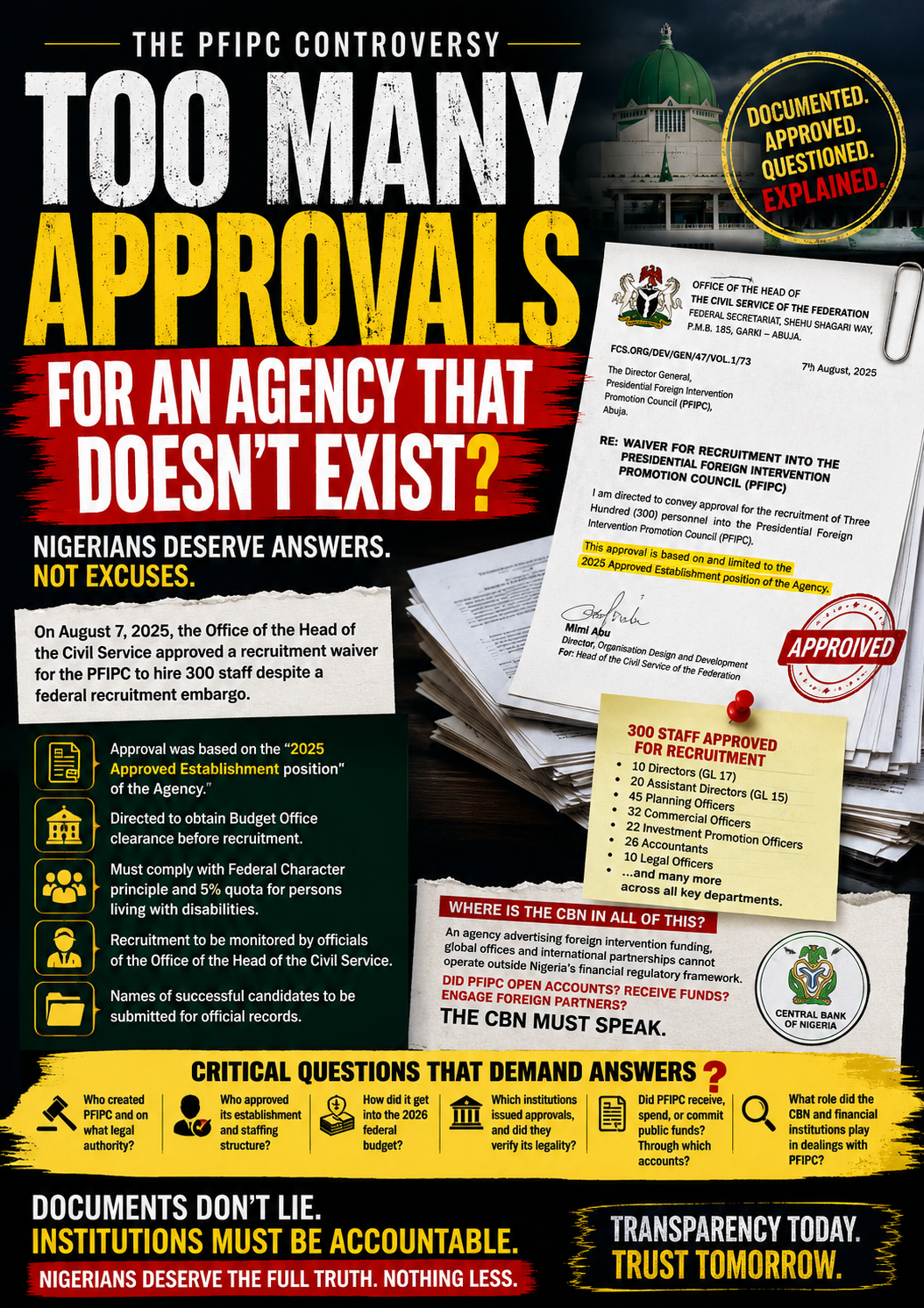
According to documents now in circulation, the Office of the Head of the Civil Service of the Federation granted the PFIPC a recruitment waiver on 7 August 2025, approving the engagement of 300 personnel despite an existing embargo on recruitment across the Federal Civil Service.
This was not a permission slip.
It was an administrative approval with far reaching implications.
The waiver reportedly authorised the recruitment of directors, assistant directors, planning officers, commercial officers, investment promotion officers, accountants, legal officers, procurement specialists, programme analysts, statisticians, confidential secretaries, drivers and several other categories of staff.
More importantly, the approval did not read like correspondence addressed to an unknown organisation.
It reportedly stated that the waiver was granted based on the "2025 Approved Establishment position of the Agency."
Those few words may prove to be the most significant part of the entire controversy.
An approved establishment is not a casual administrative expression.
Within the public service, it refers to an officially recognised organisational structure. It defines how many employees an institution requires, the grades they occupy, reporting relationships, and the positions that have been approved for funding.
Such approvals do not appear overnight.
They pass through multiple desks.
They are scrutinised.
They are reviewed.
They are documented.
That is precisely why this controversy refuses to disappear.
If the PFIPC never existed, where did its approved establishment come from?
Who prepared it?
Who examined it?
Who endorsed it?
Who signed the final approval?
Perhaps even more puzzling is what followed.
The same letter reportedly instructed the PFIPC to obtain clearance from the Budget Office before recruitment.
It directed compliance with the Federal Character principle.
It reserved five percent of vacancies for persons living with disabilities.
It required officials from the Office of the Head of the Civil Service to supervise the recruitment exercise.
It further requested that the names of successful applicants be submitted for official records.
None of these instructions is random.
Each reflects standard procedures applicable to recognised government institutions.
That naturally raises another question.
Did every official involved believe they were dealing with a legitimate federal agency?
Or did no one verify its legal status before processing these approvals?
Either possibility should concern every Nigerian.
The questions do not stop there.
Another institution inevitably comes into focus.
The Central Bank of Nigeria.
The PFIPC was publicly presented as an agency designed to facilitate foreign intervention funding, international investment partnerships and cross border financial engagements.
No organisation carrying out such responsibilities could reasonably operate in complete isolation from Nigeria's financial regulatory framework.
If the Council was engaging foreign investors, opening official accounts, receiving intervention funds, processing international transactions or facilitating cross border capital inflows, certain regulatory processes would ordinarily become unavoidable.
Did the PFIPC maintain accounts with commercial banks?
If so, under what legal identity?
Did any financial institution complete Know Your Customer verification?
What incorporation or government documents were presented?
Did the Central Bank of Nigeria receive any communication concerning the Council?
Was any regulatory approval sought for foreign financial transactions?
Were any international development partners introduced to the organisation through official government channels?
Were diplomatic missions informed that the PFIPC represented the Federal Government?
These are not speculative questions.
They are practical questions arising from the nature of the Council's publicly advertised responsibilities.
Every financial transaction leaves a trail.
Every bank account has opening documents.
Every government payment has authorisation records.
Every budget allocation has supporting files.
Every official meeting generates correspondence.
Every approval creates accountability.
The paper trail should exist.
If it does not, investigators must explain why.
If it does, Nigerians deserve to see it.
The controversy also raises broader concerns about how government institutions communicate with one another.
How many agencies interacted with the PFIPC?
Did the Budget Office recognise it?
Did the Office of the Accountant General process any requests connected to it?
Did the Federal Character Commission receive recruitment schedules?
Did the Office of the Secretary to the Government of the Federation have any knowledge of its operations?
Was the Office of the Attorney General ever consulted regarding its legal foundation?
If answers to these questions are in the affirmative, then the issue extends far beyond one individual.
It becomes an institutional matter.
If the answers are negative, another problem emerges.
How did documents bearing official signatures circulate through government without anyone questioning their legitimacy?
Public administration operates on verification.
Files move because officers certify them.
Approvals are granted because someone accepts responsibility.
Government does not function on assumptions.
It functions on records.
This is why many Nigerians are no longer satisfied with competing press statements.
Statements explain positions.
Documents explain events.
The two are not always the same.
The larger concern is the confidence citizens place in public institutions.
When one office says an agency never existed while another office appears to have processed recruitment approvals for that same agency, public trust inevitably suffers.
Investors notice.
Development partners notice.
Civil servants notice.
Citizens notice.
Confidence is built when institutions speak with one voice and when official records tell a consistent story.
At the heart of this controversy lies a simple principle.
Truth should not depend on who speaks the loudest.
It should depend on what the records show.
If the PFIPC was unlawfully created, Nigerians deserve to know who authorised documents in its favour.
If government officials exceeded their powers, those actions should be investigated.
If documents were forged, the full extent of the fraud must be uncovered.
If the Council actually received lawful approvals at one stage before a subsequent policy reversal, then government owes the public a complete chronology rather than selective disclosures.
The burden of proof now rests with institutions, not individuals.
Release the establishment records.
Release the approval chain.
Release the correspondence.
Release the legal opinions.
Release the budget documents.
Release every minute sheet that explains how this organisation moved through the machinery of government.
Sunlight remains the strongest disinfectant.
The PFIPC controversy is no longer about one Prince, one Chief of Staff or one disputed appointment.
It is about whether Nigeria's public institutions can account for their own decisions.
That question matters far more than any headline.
Because if an agency that allegedly never existed could obtain recruitment approvals, seek nationwide expansion, project an international presence and generate multiple layers of official documentation, then the issue before us is no longer merely administrative.
It is a test of the credibility, coordination and integrity of government itself.
May Nigeria Succeed
My name is Seun Olanrewaju, and Nigerians deserve the truth.
Select Thoughts & Perspectives
Quiet table. Be the first to share your perspective below.